Wednesday, 15 January 2020

TRICKS WITH CARDS AND DICE by Sean M. Brooks

In this article I focused on how Dominic Flandry used poker and dice games in some of the stories Poul Anderson wrote about that character.  I have noticed, while reading many of the works of Anderson, that the two games he seemed to most favor were poker and chess.  I will not be writing a detailed examination of how often the game of poker is to be found in the works of Anderson.  Rather, I wish to review how Flandry used poker and/or dice games for both his amusement and as one of the tools he used for carrying out his work as an intelligence agent for the Terran Empire.

A logical place to see how Flandry used poker/dice games is to start as early in his life as possible, in ENSIGN FLANDRY (Chilton Books: 1966), when he was nineteen Terran years old.  The paragraphs I quoted below came from Chapter 7 of that book.

He [Flandry] tried to laugh.  "Contrariwise.  I'm thinking about food,
fun, and females."

"Yes, females."  She [Dragoika] stood quiet a while, before she too
laughed.  "I can try to provide the fun, anyhow.  What say you to a
game of Yavolak?"

"I haven't yet straightened out those cursed rules," Flandry said. "But
if we can get a few players together, I have some cards with me and
there's a Terran game called poker."

Although we don't get a detailed explanation of how "Yavolak" was played on the alien planet Starkad, mention of that game indicates to me that Anderson believed that at least some non-human intelligent races had their own games of chance and indulged in gambling.  And the fact Flandry was willing to teach the Tigeries how to play the human game of poker would be an example of cultural interaction and change due to contact with other sophont races.  I realize some people would be disdainful about that kind of cultural interaction!

Another example I quoted is from page 14 of the 1979 Gregg Press edition of AGENT OF THE TERRAN EMPIRE, containing Anderson's revision of "Tiger By The Tail," after Dominic Flandry was captured by Prince Cerdic of Scotha: "They [the Scothani] were addicted to gambling.  Flandry learned their games, taught them a few of his, and before journey's end had won several suits of good clothes for alteration, plus a well stuffed purse.  He almost, not quite, hated to take his winnings.  These overgrown schoolboys had no idea what tricks were possible with cards and dice."  And alert readers should keep that in mind--how Flandry would use games of chance as part of his policy of using guile and subtlety to bring down the Scothan house of cards--as we see in the rest of this story!

For an additional example, on page 25 of this same edition of AGENT OF THE TERRAN EMPIRE, we can read this:

In a chamber more elegant and comfortable than the highest standards
allowed--warmth, richly hued and textured hangings, incense and recorded
music sweet upon the air--dice rattled across a table and came to a halt.
Prince Torric swore good-naturedly as he shoved a pile of coins toward
Flandry.  "You have the luck of the damned with you," he laughed.
 
For a slave, I'm not doing too badly, reflected the man.  In fact, I'm by way
of becoming well-to-do, unless my master finds out and confiscates my
hoard.

"Say rather that fortune favors the weak," he purred.  "The strong
don't need it, highness."

Here we see how Flandry used games of chance to ingratiate himself with Prince Torric, a younger half brother of Dominic's captor, Cerdic.  Flandry's object here was to sow discontent in Torric at the modest fief that was all Cerdic planned to let Torric have after the former became king.  The Terran also planned to plant the notion in the Scothan that he did not have to be content with being merely a younger son, that Torric had as much of a claim on the kingship as Cerdic.  Flandry was intriguing to spread treachery and short sighted ambition at the Scothan court.  And games of chance and dice was one means of doing so!

Next, after Flandry had gone to investigate the planet Unan Besar, the hostile government of that world forced him to seek refuge in the slums of the capital city of Kompong Timur and contact elements of the criminal underworld to obtain the assistance he needed.  Part of Flandry's plan took the form of using a variant of the Spanish Prisoner scam to deceive the gang boss Sumo the Fat.  While he was Sumo's "guest," I'll discuss how Flandry passed the time, quoting from Chapter VII of THE PLAGUE OF MASTERS.

That night Dominic stayed in the house of Sumo.  He was, in fact, a guest
for several days.  His chamber was pleasant, though it lacked windows,
and he had enough company, for it opened directly on a barrackroom
where the bachelor daggermen lived.  No one got past that room with-
out a key to the automatic lock, which Dominic didn't ask for.  He messed
with he daggermen, traded jokes, told them stories, and gambled.  Cards
on Unan Besar had changed faces, but were still essentially the same old
pack of fifty-two.  Dominic taught the boys a game called poker.  They
seized on it avidly,  even though he won large amounts from them.  Not
that he cheated--that would have  been fatal, under so many experienced
eyes.  He simply understood the game better.  The daggermen accepted
the fact, and were willing to pay for instruction.  It would take many years
to get back from neophytes elsewhere all that Flandry eventually won,
but the Pulaoic mentality was patient.

Yet another example of cultural change and interaction by means of gambling and games of chance!  Here we see Flandry, unlike on Scotha, using gambling for amicable ends, making friends with Sumo's buttonmen (to use a term from the American Mafia).

Years later, in Chapter XII of WE CLAIM THESE STARS, after Flandry had deliberately let himself be captured by the Ardazirho aliens who had invaded the Empire and seized the planet Vixen, we see this as he was taken through various compartments in the enemy headquarters den: "Or it might be a roomful of naked red-furred shapes: sprawled in snarling, quarrelsome fellowship; gambling with tetrahedral dice for stakes up to a year's slavery..."  The interest here being how we see another example of non-humans who were as fond as gambling as humans can be.

In addition, in Chapter IV of A KNIGHT OF GHOSTS AND SHADOWS, we see Chives, Flandry's invaluable butler/valet/chef/pilot, et al, a non human native from the planet Shalmu, explaining to Kossara Vymezal  how he and Flandry came to meet.  Chives had been one of the victims of Aaron Snelund's illicit trafficking in slaves from Shalmu and eventually ended up working in a mercury mine on an unnamed planet where Flandry  came across Chives by chance.  Disapproving of how Chives and the other miners were treated, Flandry took steps to correct the situation.

"I was not prepossessing, Donna.  My owner had put me up for sale
because he doubted I could survive more labor in his mercury mine.
Sir Dominic did not buy me.  He instigated a game of poker which
lasted several days and left him possession of mine and workers
alike."

Chives clicked his tongue.  "My former master alleged cheating.
Most discourteous of him, especially compared to Sir Dominic's
urbanity in inviting him out.  The funeral was well attended by the
miners.  Sir Dominic arranged for their repatriation, but kept me
since this was far from Shalmu and, besides, I required a long course
of chelating drugs to cleanse my system.  Meanwhile he employed
me in his service.  I soon decided I had no wish to return to a planet
of...natives...and strove to make myself valuable to him."

Here we see how Dominic Flandry not only first met Chives but also taking steps to correct some of the longer term consequences of Snelund's abusive governorship of Sector Alpha Crucis.   AND, albeit through somewhat questionable means, eliminated a smaller abuser of authority.  A bit later, in the same chapter, Chives conceded: "The fact is, he did cheat in that poker game."  Chives' former master should have accepted the loss of his mine instead of fighting a duel with someone as lethally deadly as Flandry!

Let's backtrack a bit, to expand on what Chives said about how he became a slave.  Legally, slavery was used in the Empire as one means of punishing criminals.  For example, at the very beginning of "Warriors From Nowhere," this is part of what Dominic Flandry said: "If you shoot your neighbor in order to steal his property, you are a murderer and a thief, subject to enslavement."  The abuse in Chives case from Snelund's agents using  "questionable" (false) charges to justify trafficking in slaves from Shalmu.  In addition,  we read this in Chapter V of THE REBEL WORLDS: "Snelund isn't stupid, worse luck. Maybe no big, spectacular warriors or statesmen can topple him.  But a swarm of drab little accountants and welfare investigators isn't that easily fended off."  I interpreted this to mean efforts were made, using these accountants and welfare investigators, to control, reduce, and penalize abuse of the system of using slavery as a punishment for crime.

It was interesting to note the various uses Flandry made of the game of poker.  Sometimes, as on Starkad and Unan Besar it was for amicable reasons (although it was useful and prudent to be on good terms with Sumo the Fat's daggemen).  Other times, as on Scotha, Flandry used dicing and gambling as a political tool, to help subvert and undermine the Frithian domination of Scotha, and nullify a serious danger to the Empire.  And even though we don't see Flandry using poker in WE CLAIM THESE STARS, I thought it was still interesting to see non-humans like the Ardazirho gambling.

Readers will also see Flandry using metaphors taken from the games of chess and poker, either for making a philosophical point or for describing problems and dangers faced by him.  Examples of the former can be found in Chapter 23 of THE GAME OF EMPIRE (quoted in my ANDERSONIAN CHESS essay).   For the latter I quoted from Chapter XV of A CIRCUS OF HELLS, when Flandry believed himself to be in a very dangerous situation: "Flandry's head had gone winter clear. He had but to call them, and ideas and pieces of information sprang forward.  Not every card had been dealt.  Damn near every one, agreed, and his two in this hand were a deuce and a four; but they were the same suit, which meant a straight flush remained conceivable in those spades which formerly were swords."  Not being a poker player, I don't claim to entirely understand these metaphors!

It's also safe to conclude from all this that Flandry, had he so wished, could have done very well making a living as a professional poker player!  It's amusing to think of him, had Flandry lived in the 21st century, gambling in the casinos of Las Vegas or Monaco, and with no need to cheat, given his skill with this game.

Monday, 19 August 2019

Review of Perish by the Sword by Poul Anderson

This review of Perish by the Sword by AM Romer will be at the top of the blog for the next week. Newer posts will appear below it.

The outstanding thing about Perish by the Sword is that Poul Anderson has captured a particular time and place perfectly. It’s like a tourist’s guide to Northern California, 1959. You can see it, hear it, and feel it in the air. Here are the Berkley scientists in their labs and offices, the post-war tech, and Russia forever in the background. Here are the San Francisco Bay houses, complete with sunken lounges and after-work martinis, and the women with their cropped hair, their own jobs and their own sports cars. And here’s the bar, Howl, full of beat poets (of course) and groovy cats, and young men who’ll do anything for ‘the experience’. The sense of place and time he’s given us is awesome; it’s a gift, and that’s the joy of this book. But unfortunately, what is joyless outweighs it.

In an interview (find it here), Anderson explains how he begins to conceive of a book: he wants to say something about a particular topic – a philosophical concept or thought experiment, or an observation on the political and social movements around him, for example – and then develops a story around that. It sounds great for sci-fi. Arguably, the motivation at the core of all sci-fi is the question What if…? But this is where Perish by the Sword falls down.

It reads as though the author has made a decision to write a novel in the ‘detective’ genre, maybe as a kind of exercise, to see if he can do it. He has developed his plot points, the crime and the solution, and the elements of contemporary culture he wishes to include, and then – and only then – has he populated this plot with characters. It’s as though he has precisely mapped out all the moves in a game of chess for both players, and then carefully places the pieces on the board in their required positions, rather than letting the game unfold. The plot is enacted by the characters – it does not grow naturally from them. There is the strong sense that they exist mainly to fulfil plot points and genre requirements, whereas great characters seem to have a life of their own and are caught up in events which they or other characters have created. The result is that I can’t care about them. I don’t care if they live or die; they are items moved upon a game board because the author needs them to move. This results in a distinct lack of tension – because I don’t care enough to be invested, to worry about the wrongly accused or who might next be put to the sword.

Even their names felt carefully constructed, along with their background, psychological profile, linguistic habits, eccentricities of behaviour and interests. Yes, the name Trygve Yamamura indicates his ‘San Francisco melting pot’ heritage, but it will never get this detective into the canon. And Colquhoun (huge, fiery-tempered bloke with a suitably Scottish moniker) was slowing the pace – not because of his character, but because of having to read and then remember how to pronounce his name.

For someone who is a seasoned reader in the crime genre, the perpetrator stood out from the beginning. In fact, it seemed so obvious that I thought there must be a twist, and it was the thought of this that kept me reading… but there was no twist. By the end, when Yamamura gives a straightforward walkthrough of the murder and how it was done, I’d already been waiting some time for the characters to catch up to what I already knew. If this doesn’t happen quickly, it doesn’t matter how brilliant the writer is in terms of language or imagery – frustration sets in. Some elements of the denouement were a surprise, hinging as they did on the tiniest, seemingly throw-away lines and observations. But rather than coming across as ‘clever’, so that the reader has that rush of revelation, Oh, of course! Why didn’t I see it? that characterises the best Poirot stories, it felt almost mathematical: the clues so carefully scattered, gathered together at the end by the detective into a neat equation, but one I had no real interest in working out.

People love to solve problems. The detective story is a sophisticated series of problems and puzzles, and good ones test their readers’ knowledge of human psychology, as well as their familiarity with the conventions of the genre itself. Perish by the Sword was not so much a test for the reader as an illustration of Anderson’s ability to create a plot. The characters were figures made to fulfil the plot’s requirements: the detective, the victim, the suspect, the love interest, the murderer. And the overall reason for the book’s existence felt like it was an exercise for a very intelligent author in ‘writing a murder mystery’. Detective Yamamura occasionally showed glimpses of being his own person, rather than the author’s puppet, but in the end he too felt like a chess piece in an intellectual game. So despite my fantastic tour of Berkley and San Francisco in the late 1950s, I was left cold and, ultimately, bored by the novel – and by the characters who played out their pre-assigned roles and behaviours exactly as planned. 

AM Romer
August 2019

Monday, 4 February 2019

The Broken Sword, Original And Revised, Part One, by Nicholas David Rosen

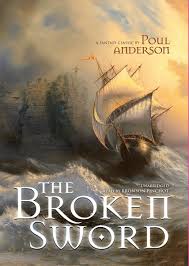
I was at college in the first half of the 1980s when I found and bought a copy of THE BROKEN SWORD; it was the revised 1971 edition, with a preface by Poul Anderson, explaining how he had cleared the “wordbrush” and substituted one Person for another in a brief but important scene.  Elsewhere, Sandra Miesel expressed the view that the revised edition was an improvement, and wrote that subsequent quotations in her essay were from the revised edition.

I recently found a trade paperback of the original version on sale, with an introduction by Michael Dirda, and bought and read that.  The remainder of this post is directed primarily to Anderson fans who have read the book, but should also be of interest to book lovers who have not; while I will not recount the plot, those who do not want to learn anything about the events before reading the book had best cease to peruse this post.

The writing of the original version is less polished than the revision, and contains various typographical errors, although I do not know whether they were slavishly copied from the first printing, or newly introduced.  Plural possessives throughout the book use double quotation marks instead of single apostrophes.  “Monsters of the Wood of Grendel” should be “Monsters of the Brood of Grendel”, and a troll speaks of lying beside a human man, where “human may” (maiden) seems much more likely.

There are other changes which, in my view, improve the revised edition.  The revised edition describes Orm, at the grace-ale for his son Ketil, maintaining his cheer “as befitted a warrior who had contempt for death”, a memorable phrase lacking in the original.  In the revised edition, as I recall it, Imric describes his foster son Skafloc’s enthusiastically war-loving verses upon receiving his new steel weapons and armor as well said “if a little boyish.”  In the original, Imric’s words do not include this sound critical comment.

In both editions, milk from the infant Skafloc’s elfin wet-nurse Leea was sweet fire in his mouth and veins, but in the revised edition, “her milk” becomes “the milk which she brought forth by no natural means.”

Although the writing of the first version left room for improvement, in the author’s opinion, Sandra Miesel’s, and my own, the twenty-seven year old Poul Anderson accomplished more than telling a gripping, heroic, and tragic tale in a fully adequate prose style.  He wrote the book in several prose styles, using a spare, saga-like style for the opening tale of Orm, a lusher prose to describe Skafloc’s childhood and coming of age among the elves, and a style suggestive of a late medieval romance to describe Ketil’s being led astray and coming upon the witch in the guise of a beautiful young woman.  Anderson also composed a number of poems in alliterative verse (some rhymed as well) for the characters to recite in a variety of contexts and moods.  This would have been an impressive achievement for a writer of fully mature skill.

If you have not read the book, and are at all attracted to heroic fantasy of a grim Nordic sort, where heroes, villains, and bystanders are slain, and any women not dead themselves are left to grieve their heart-breaking losses, yet people dree their weirds bravely, with undaunted resolution, THE BROKEN SWORD is for you.  I prefer the revised edition, but either version provides a gripping tale and exceptional literary experience.

The Broken Sword, Original And Revised, Part Two, by Nicholas David Rosen

There is something more to be said about the differences between the two versions of THE BROKEN SWORD; saying this does not give away the whole story by any means, but it does hint at what will happen in the course of the tale, so those who have not read THE BROKEN SWORD and hope to do so may wish to refrain from reading further.

In the original version of the book, the witch summons Satan twice.  The first time, he advises her on how she can achieve revenge against her enemies (including the wife and children of the Viking chief who slaughtered her family and took their land).  The second time, a band of elves dispatched by Earl Imric are seeking her life, so she calls upon her master Satan to preserve her.  He refuses, calling himself the lord of evil, which is futility, and leaving her to be killed.  It is nothing to him whether she lives to see her revenge completed, and he tells her that she is not his servant, but his slave.

In the revised version, the first summoning appears to be much the same, with the prose tightened somewhat, but the witch sees Someone departing who appears to match the description of Odin.  It does not matter much to her with whom she deals, provided she can avenge her son and other kindred.  When she summons Satan again, the genuine enemy of souls replies to her, but this time says, in addition to his other icy words, that she did not deal with him, but with another.  He also makes another chilling statement absent from the original version:  “Mortals never sell me their souls.  They throw them away.”

Whether or not one believes literally in the Christian God and the chief fallen angel, there is a warning in that.

As a literary matter, both versions work: Odin is also active and plotting in the novel, and could have helped the chain of events along by appearing to the witch in another’s guise; or the Devil could have given the witch evil counsel to assist her in doing his work.  I prefer the revised version, both because the writing is improved, and because the advice which the witch hears the first time, although directed to an evil purpose, is wise and poetic.  It seems more natural coming from the mouth of Odin, who is Machiavellian but not all bad, than from the mouth of Satan, who is.

Monday, 28 January 2019

Perish by the Sword: A Review by Nygel G. Harrot

The pen is mightier than the sword… Or is it?

Does Poul pull off a murder mystery as well as dear old Agatha or is the sword in the title really just a blunt knife?

Now, I must admit that this is the first Poul Anderson book that I have in fact read. I have not yet traveled the depths of time with him via the Time Patrol series.

 As a follower of good mysteries containing bodies on vicars’ hearth rugs I thought I would try this well known author from the 50s onwards, despite a word from Mr. Paul Shackley  that, for him, this was not one of his favorite Poul books. (The sword stays firmly in the time period that it is set in and does not slip into a different stream or dimension of history, past or future.)

To be honest, I set up my camp with Mr Shackley, although a few tents along.

The mystery was solid.

The writing very good.

The words used created the atmosphere and the feel of the late 1950s (the book itself was written in 1959 and was the winner of the ‘Cock Robin’ mystery award).

But for me the problem was the bit between the lines. The feel of the characters and situation as I took my eyes off the page and turned it. They were lost to me until I hooked onto the words again.

If an Agatha Christie story was a painting, it would be a fine line drawing shaded with water colour pencils containing the odd patch of heavy red. Poul’s, on the other hand, would be a solid ink illustration, logically made up of thick firm black lines. With no shading.

After the sword had been wielded for the last time, after the culprit had been revealed, after the book had been closed, I didn’t have the feel of heart to want to join some of them again for the two follow up books (Murder in Black Letter and Murder Bound).

A solid read. But without the depth of characters that I can connect with.
5 out of 10.

Tuesday, 15 January 2019

Weapons Technology in the Technic Civilization Stories by Johan Ortiz


Flandry with blaster and stunner 

Blasters and stunners and needlers, oh my!


The Technic civilization stories are not hard military sf in the style of for example David Drake. Nonetheless, Poul Anderson took some care regarding the kinds of weaponry his heroes and their foes would use. There are auto-guided missiles, most carrying nuclear warheads. There are energy weapons, so called “Blasters” which are not lasers – note how Technic “blaster cannon” are contrasted with more primitive Merseian lasers in a one-sided confrontation in THE DAY OF BURNING. Ships and men are protected by armour, which delay damage from blasters by virtue of having to be burned through first, but also by “force screens” which deflect or absorb incoming energy, such as blasters and lasers. Laser weapons seem to be considered obsolete, since they are only used by the (at the time) backward Merseians. Possibly they require more power than blasters for any given level of energy on target, making them impractical as hand held weapons.

Moving on to personal weapons, beside the mainstay blasters, there are “stunners”, which seem to be some sort of non-lethal energy weapon. There are slug throwers – we can assume this is the future name for old school projectile weapons in an age where a “gun” naturally refers to a blaster. And finally, there are “Needle guns”. Although the more usual seems to be carrying only two guns, blaster and stunner, the formidable Chee Lan likes to carry around a panoply of the four previously mentioned types of guns, as she did when exploring old ruins on the planet Dathyna in SATAN’S WORLD.  Chee Lan’s arsenal is interesting, as it indicates that different types of gun have their distinct purposes, or at least strengths and weaknesses important enough to warrant the carrying of four different weapons in some situations. Let us explore these four types in turn.

Blasters

Beginning with the ubiquitous “blasters”, we can infer from the descriptions of their use that they are some form of directed energy weapons, and most probably neutral particle beam weapons. Such a weapon creates charged particles or ions by stripping atoms, to be used as projectiles, of some of their electrons. Once possessing a charge to be able to be affected by magnetism, these ions can be accelerated in much the same way as metallic slug in a magnetic rail gun. In the case of atomic or subatomic particles, relativistic speeds could be attained, up to near light speed.

A charged particle beam would soon scatter because homogenously charged ions would repel each other. For this reason, to create a beam of uncharged (neutral) particles, electrons are reattached to the ions just prior to leaving the projector, restoring them to proper atoms. Using uncharged particles has another advantage – a charged particle beam could easily be dispersed in the same manner as its component particles where accelerated in the first place – with magnetism. A magnetic screen would however be useless against a neutral particle beam. Since blaster beams are not described as scattering even in space combat between starships with ranges of hundreds or thousands of kilometres from gun to target, we can reasonably conclude that blaster beams, (if particle beams at all) are indeed neutral particle beams.

Such a beam would be mostly invisible in space, except where it collided with the occasional atom of gas or particle of dust, causing a light flickering here and there. In an atmosphere, the particle beam would flash brightly as the particles collide with atoms in the air and gradually lose power. This is consistent with the brightly white beams described by Poul Anderson, for example in THE MAN WHO COUNTS. Such a particle beam would be a devastating weapon, inflicting damage through kinetic force, heat and ionization. If we imagine the mass of one hit as being one millionth of a gram, at half the speed of light that would mean roughly 17-18 times the power of a .45 ACP round. While the weight of ammunition would be negligible, power requirements would not and would constitute the limiting factor in determining how many times a blaster could be fired before needing a reload. In theory, and surprisingly, a simple AA battery has enough power for two such shots, given an (admittedly unlikely) 100% efficiency. It is not then unimaginable, given a few hundred years of technology development, to have a magazine-sized power pack (with an integral small amount of heavy metal to be fired) capable of firing two or three dozen blaster shots.

We note that blasters can be set to a “needle beam”, i.e. a very narrow beam, in order to more likely cause incapacitating injuries rather than death. This is entirely feasible, indeed one important difficulty with a particle beam weapons is making the beam wide enough to cause significant damage. A short needle pulse could pass through a target causing minimal damage, as in fact has happened in laboratories such as CERN, where in at least one incident a scientist accidently had a particle beam fired straight through his head. Being the width of a single molecule, it caused no discernible damage at all!

As an interesting aside, the atoms used as projectiles could be of many kinds, but heavier ones would be more devastating at any given speed and would lose speed at a slower rate than light ones. If using poisonous heavy metals such as mercury, lead or perhaps plutonium, the victim of the blaster would not only be pierced and burned – he would be poisoned! Fortunately, the Technics seems too civilized for this, since Adzel in particular is shot repeatedly with blasters and is never poisoned.

Stunners

Moving on to stunner guns, it is much less obvious how they are supposed to work. At first glance I suspected they might have been electro laser “lightning guns”, where a short pulse laser ionizes atoms in its path to plasma, creating a conductive channel, through which an electric discharge is sent, presumably knocking out the target, much in the same way as a police taser. Such a weapon would probably have a short range, given that the electric discharge need to find less resistance in the plasma channel than any other route to grounding. Note that an electro laser could easily be made lethal, simply by ramping up the electric charge. It could also be used eminently well to fry electronics.

Curiously I found both support and evidence against this theory in the same passage in A CIRCUS OF HELLS:

A purple light ray flashed, guiding the soundless hammer-blow of a supersonic beam.

So indeed, the stunner is a two-component weapon and has a guiding beam, just like what we would expect from an electro-laser – but the discharge of such a weapon would look like a bolt of lightning, rather than a “purple light ray”. Also, the actual stunner beam is explicitly described as a “supersonic beam”, not an electric bolt. This is also the only way stunner weapons are described in other stories, such as SATAN’S WORLD – as firing “supersonic beams”. When googling for that phrase, one finds mainly references to “supersonic molecular beams”:

…supersonic molecular beam, which is generated by a free jet expansion source. Gas expands isentropically with molecular velocities greater than the speed of sound. The translational and vibrational energies of the beam can be independently controlled, and hence the energies of molecules that impinge on the surface.

If this is what Poul Anderson had in mind, we’re dealing with a jet of gas moving at very high, (indeed, supersonic) speed. A narcotic effect cannot be entirely ruled out, although it would require exposed skin and compatible biochemistry for the weapon to work. Still, the effect being immediate, one would guess the victim is rendered unconscious through concussion, rather than by any narcotic effect from the gas. This notion is reinforced by the descriptive “hammer-blow” delivered by the beam. I cannot say if the propagation and/or direction of a supersonic jet of gas would be aided by creating an ionized conduit for it, as would an electric current. It does not seem entirely implausible that it would tough. The range of the weapon would still be rather short. In order to reliably stun a target, the “hammer-blow” would have to be aimed at the head, pretty violent and potentially lethal, as blunt force often is. While this might be a reasonable explanation how a "supersonic beam" could be used to stun a target, it is not consistent with how stunner effects are described in the stories.

There is however another possibility. According to www.vocabulary.com

Originally, the word supersonic meant "having to do with sound waves beyond human hearing," but by 1934 it described movement exceeding the speed of sound, with ultrasonic taking on the old meaning.

It is possible that Poul Anderson was using the term “supersonic” in the old sense, what we today would call ultrasonic. Ultrasound have long been studied for use as a non-lethal weapon, and could potentially affect a target's nervous system, cause violent muscle contractions and/or affect the inner ear and balance system. This does sound a lot like the described effect of a stunner, although the point of the guiding purple light ray then becomes more obscure.

Projectile weapons

Slug throwers are not often used in the stories, and this seems logical when blasters would appear to be the better weapon in every way, excepting only the issue of visibility. The blindingly white particle beam of a blaster would immediately give away the position of the one firing it, whereas a traditional chemical energy projectile weapon would not. But this would seem of more importance for a sniper’s gun than for a handgun, and a high-power laser – silent, invisible, without bullet drop and with instant effect on targets within visual range – would seem like a far better choice for that purpose. There might however be one situation in which the archaic slug thrower would be the superior choice, namely against a target protected by an energy screen. These devices seem to dissipate directed energy beams such as blasters and lasers, but a solid projectile might conceivably pass right through it. Otherwise it is hard to imagine why Chee Lan would burden herself with one.

As for Chee Lan’s fourth gun, the “needle gun”, it is not clear what kind of weapon is intended. Historically, a “needle gun” was a precursor to the bolt action rifle, in which a needle would pierce a paper cartridge to hit a primer inside the cartridge, at the base of the bullet. This is obviously not what Poul Anderson had in mind. As previously noted, a blaster can be set to “needle beam”, thus not necessitating a special kind of gun to fire one. The needler must be some other type of weapon.
Most sci-fi references to needle guns seem to refer to a rail gun type of weapon magnetically firing a small needle-shaped projectile. It is hard to see what such a weapon system would have going for it compared to a blaster, except, again, stealth. If the needle is fired at supersonic speed, then the weapon will be rather loud, producing a sonic bang (comparable to the cracking of a whip) with every shot, but there will be no visible white beam. The range will be short, as a lightweight needle will quickly lose momentum in air. However, such a needle could well be carrying a drug or poison, and in fact we have a reference supporting that notion. In THE PLAGUE OF MASTERS Flandry ponders the use of a “a cyanide needler with a compressed air cartridge”. It would seem then that Technic needlers are not magnetic coil guns after all, but rather compressed air tranquilizer guns firing drug-carrying needle projectiles. Such a weapon could be used as a substitute to a conventional stun gun or if using lethal poison, as an assassins tool.

Sunday, 30 December 2018

The Astronomy Of The Technic Civilization Saga by Johan Ortiz

-Hard science, artistic license and obsolete data-


The son of an engineer and with an education in physics himself, Poul Anderson was not shy about including hard science in his fiction. While future tech was often handwaved off with a minimum of techno-babble, when it comes to strange stars and planets, we get a veritable catalogue of facts from spectral type of the star, the axial tilt of the planet, even in some cases including the geology of his worlds! And while he did create a lot of fictional stars, he also made use of real ones when building his future histories. This is very apparent in his Technic civilization stories, where some actual stars are recurring “characters” together with some fictional ones. It is notable that in that series of stories, most of the action takes place either in the Sol system or in rather distant star systems. Hardly any Technic story takes place within 20 light years of Sol (excepting Sol itself). Staple stars of science fiction like Epsilon Eridani, Sigma Draconis or Tau Ceti are seldom mentioned. In a rare exception, the future first Emperor of Terra, Manuel Argos, is captured by the Gorzuni on Alpha Centauri. Another relatively close system mentioned is Chee Lan’s home planet Cynthia which orbits Omicron 2 Eridani A, 16,3 LY from Sol.

The position of the real star systems used, just as the fictional ones, are often described at least relative to the Sol system – and it is here that the advancement of science has made a disservice to Anderson’s work. During, and especially after the period during which he worked on the technic civilization saga, the data we have on the distance from Sol of many of the stars mentioned in the stories have improved considerably.

Because we do not know with certainty the absolute luminosity of a distant star – we cannot really tell at a glance if it is a shining giant at an enormous distance we are seeing or a modest dwarf closer to Sol – we can measure distance from us by using the parallax method. It is how our depth vision work. Just as our brains can calculate the distance to an object through (among other means) the slight difference in angle between the picture of either eye, astronomers can measure the angle to a star at two points in time. Using the difference in angle between the two observations, trigonometric calculus can give an estimate of the distance to a star. However, the more distant the star, the smaller the angle is and the harder it is to accurately calculate the distance. And in this, the state of the art has advanced considerably since the 1950s. For example, in the 1990s, close to the end of Poul Anderson’s career, the Hipparcos mission obtained parallaxes for over a hundred thousand stars with a precision of about a milliarcsecond, providing useful distances for the first time for stars out to a few hundred parsecs (a parsec is equal to about 3.26 light years). With the Hubble telescope we can today reliably determine distances out to 5 000 parsecs. None of this was possible in the 50s, 60s or even 70s.

This coupled with the fact that the Technic stories involve mainly distant stars has caused the distances mentioned by Poul Anderson to become very dated. I shall name a few examples.

In A SUN INVISIBLE, the distance from Sol to Beta Centauri is given as 190 LY. Currently, it is believed to be 397 LY. In SATAN’S WORLD, the Serendipity supercomputer tells David Falkayn that Beta Crucis is 204 LY from Sol. Currently it is believed to be 287 LY. Note that this also means that the author thought of these two stars as being be much closer to each other than what we now believe.

The obsolete data for distance to real stars have consequences also for the locations of fictional ones, since their position is often described as relative to real stars.

In WINGS OF VICTORY, in which an Earth star ship of The Great Survey visits the Home world of the avian Ythrians, their star is said to be “beyond the great stars Alpha and Beta Crucis”, “in the constellation Lupus” and “278 light years from Sol”. As mentioned earlier, this is inconsistent with modern data, since the closer of the two stars, Beta Crucis is about 287 LY from Sol, and Alpha Crucis is 326 LY. To be considered “beyond” both these stars in any sense of the word, Ythri must be no closer than 326 LY to Sol. Add to this that Ythri is to be found in Constellation Lupus, not Crux as Alpha and Beta Crucis, that is to say a considerable distance to one side of Crux.  If we are truly to consider us to be “beyond” and not “beside” Alpha Crucis, we would have to increase the distance further – exactly how long is impossible to determine, but one could safely assume another 100 LY at the least, to place A .Crucis “behind” rather than beside us.

But we have more clues in other stories. In THE PEOPLE OF THE WIND, the Terran Empire initiates a war of conquest against the Ythrians. Among the reasons are to secure for Terra the system of Beta Centauri, around which orbited several Krakoan- and one human-inhabited worlds before Ythri might beat them to it, as they already had with the Dathyna-system (from SATAN’S WORLD). Beta Centauri is, also as mentioned, 397 LY from Sol, and while it is not inconceivable that Terra and Ythri would dispute a system beyond Ythri from Sol, intuitively we would assume that the disputed systems are between the two. Beta Centauri is not mentioned as a close neighbour to Ythri in “wings of victory”, which makes sense since we know that the author believed B. Centauri to be only 190 LY from Sol, we can conclude that he also thought of Ythri as being no closer to B. Centauri than 88 LY (which would any way require it to be behind Beta Centauri and in Constellation Centaurus, not Lupus). These considerations would lead us to the conclusion that Ythri is near to 500 LY from Sol.

Another problematic set of data appears in Anderson’s Dominc Flandry stories set in the decadent Terran Empire of the early 31st century. The Empire is said to control a rough sphere with a radius of two hundred light years including around 4 million stars – but within that sphere are Beta Centauri (397 LY away), Alpha Crucis (326 LY from Sol), Beta Crucis (287 LY) and Antares (609 LY from Sol). Betelgeuse (642 LY from Sol) is not within the Empire, but a buffer state between Terra and Merseia (which is said to be located in “the wilderness between Betelgeuse and Rigel” in THE DAY OF BURNING). To make matters worse, Antares and Betelgeuse are almost exactly opposite each other from Sol. The Empire thus claims space up to more than 600 LY in both these directions.

Another problem is that within a sphere with even a 250 LY radius from Sol, there are in the proximity of 260 000 stars, so nowhere near the 4 million stars mentioned. That amounts to about 0,0038 stars per cubic light year. Using this star density, it would require a sphere with a radius of almost 630 LY to include 4 million stars.

On the other hand, in THE REBEL WORLDS, Polaris and Deneb are said to be “unutterably far beyond the Empire and its enemies”. This is doubtlessly true about Deneb (1 547 LY from Sol) but Polaris is “only” 431 LY from Sol, that is to say closer  than both Antares and Betelgeuse and also notable for being on one end of the sphere controlled by the Polesotechnic League in the era of Van Rijn and Falkayn, which held sway “from Polaris to Canopus” (Canopus is 313 LY from Sol, by the way). While it is mentioned by Flandry that the Polesotechnic League explored far beyond the Empire’s reach, it is odd that Polaris should be considered “unutterably” beyond the Terran sphere, when being closer to Sol than some of the Empire’s more notable border systems.

None of the this would really be problematic unless for the oft-repeated statement that the Empire controls a “rough sphere” 400 LY across, or with a radius of 200 LY. An Empire that controls Antares, Alpha and Beta Crucis, Beta Centauri and which borders Betelgeuse but otherwise only holds sway out to a radius of 200 LY from Sol is not a sphere – rather it is shaped like a three-dimensional starfish!

Now, how to reconcile these inconsistencies with Poul Anderson’s texts? One way is to decide that the entire universe is fictional, and that in the universe of the technic civilization, Beta Crucis really is only 200 LY from Earth. Another approach is that of “minimum rewrite”, i.e. to ignore those measure of distance given by the author that are inconsistent with modern data but accept all other facts – in other words, accept that Antares is an Imperial system, and Betelgeuse is a buffer state, and thus conclude that the Empire is over 1 200 LY across between those systems. That would also mean accepting that the Empire, as stated, is a rough sphere rather than a starfish, but that it is a sphere with a diameter of roughly 400 parsec (rather than light years). Interestingly, the earlier mentioned radius of a sphere required to englobe 4 million stars, 630 LY, corresponds to 193,1 parsecs. A sphere with a 200 parsec radius would hold, on average, 4,4 million stars. Close enough!

Not all astronomic inconsistencies in Anderson’s work stem from obsolete data however. Above all, he was a writer of fiction, and as such he would engage, from time to time, in artistic license. In WE CLAIM THESE STARS, the dastardly Merseians are trying a land grab (or star grab perhaps?) in the fictional Syrax star cluster, which, if held by the Merseians would “bypass Antares” (presumably an imperial bastion) and thus hasten the demise of the Terran Empire by a century or more. The only problem is that, as mentioned before, Antares in constellation Scorpio is on the exact opposite side of Sol from constellation Orion where Merseia orbits the star Korych between Betelgeuse and Rigel (according to THE DAY OF BURNING). Thus, if we are to take this at face value, the Merseians have completely surrounded the Terran Empire at least on one side and can threaten it from the exact opposite direction of their home world, more than 1 250 LY away, in a straight line and more than 2 000 LY away if they have to fly around the circumference of the Terran sphere. Assuming speeds similar to those given in SATAN’S WORLD (Sol to Beta Crucis in two weeks), such a journey would take close to 100 days. It could be less, if the state of the art of hyperlight travel has improved in the centuries since SATAN’S WORLD, or it could be more, given that the estimated travel time in that story was for a small, swift ship for a few passengers. A heavy battlefleet might be considerably slower. The Merseian fleet at Syrax could well have made a journey comparable in length to that of the ill-fated Russian Baltic Fleet sailing to Tshushima in 1904-1905 (which took around six months).

On the other hand, we are told the Merseia threatens the Empire on its “Betelgeusan flank, and the barbarians everywhere else” – the Empire does not have Merseia around half of its periphery. This leaves a distant Merseian base the only possible explanation, perhaps similar to Cuba becoming a Soviet base during the Cuban missile crisis. That analogy makes clear the problem with that assumption obvious – while the US would have very much deplored and opposed a Soviet attempt to take over, say Haiti from its Cuban base in 1961, the really big beef was having Soviet missiles on Cuba in the first place.

By the same token, if the Merseians were threatening Syrax from a distant exclave in Constellation Scorpius, then surely it would be worth at least a passing mention by Flandry or his superiors? Such a base would constitute a major strategic conundrum for Terra, far more important in itself than the fate of the Syrax cluster and one it could scarcely leave unaddressed, even in it morose decadence. Nonetheless, this is what the reader will have to assume, if we are not to dismiss the premises of the story out of hand!

In this case, obsolete data are not to blame – the directions of Antares and Betelgeuse where as well known in 1969 when that particular story was written as they are today.  But Antares had been used in several prior stories and connects the reader with the Technic universe through familiarity of places and names. It will be noted though that never in the story does Anderson say that Antares is anywhere near Betelgeuse or Korych. The inconsistency is not in astronomy but rather in somewhat implausible geo- or rather astropolitics.